
Agrarian Emergency in Bali: From Land Inequality to Women's Voices
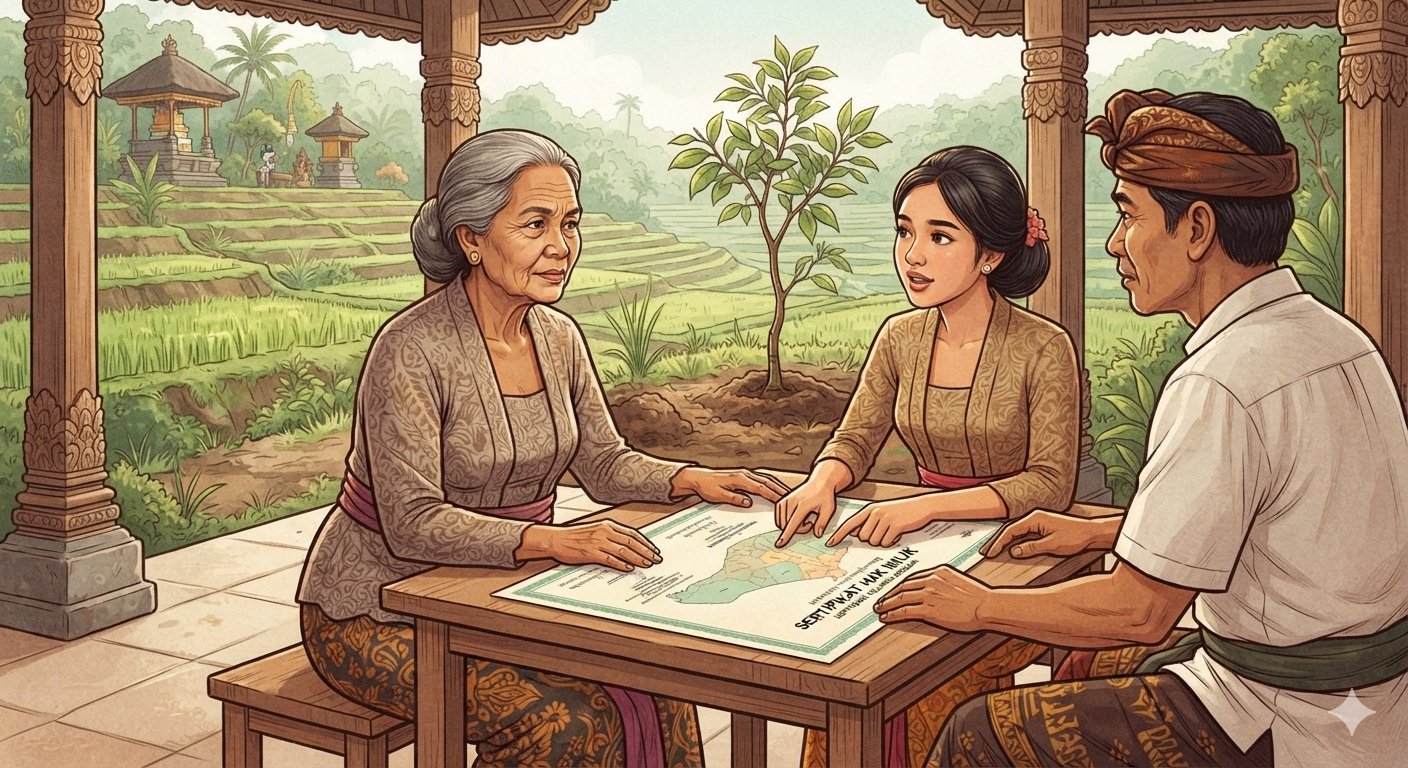
Ilustration
notarynews.id Denpasar - In Bali, land is not merely an expanse measured, registered, and attached to a certificate. Land is a space where life grows: rice fields that provide food, homes that shelter families, places where customary and cultural life takes place, and spaces that connect people with their communities. Therefore, when land changes control or use, what actually changes is not only the status of a piece of land, but also the way of life and future of those who depend on it.
Amid the rapid growth of investment, tourism, and development that continues to seek new spaces, questions about Bali’s land are becoming increasingly urgent: who controls the land, whose interests does the land serve, and who ultimately has to lose their living space? Behind investment figures and the economic value of land are farmers, indigenous and customary communities, families, and women who are often on the front line when their living spaces come under pressure.
This is where the expression “Yeh Mata Ring Gumi Bali” (Tears of the Land of Bali) gains its meaning. Land is the mother of life. When land loses its social function and is viewed merely as a commodity, what is at risk is not only the land itself, but also the lives that grow and depend upon it.
A discussion held to commemorate National Farmers’ Day (Hari Tani Nasional/HTN) and the 66th anniversary of Law No. 5 of 1960 on Basic Agrarian Regulations (UUPA) brought together academics, legal practitioners, socio-cultural observers, and farmers’ representatives. Speakers included Ni Nengah Budawati, S.H., M.H., Director of the Bali Women Crisis Centre Legal Aid Institute (LBH BWCC); Ni Nengah Kisid of the Buleleng Farmers’ Union (Serikat Tani Buleleng); Dr. I Made Pria Dharsana, S.H., M.Hum., legal practitioner and notary in Badung Regency; Ni Made Indrawati of the Bali Regional Coordinator of the Agrarian Reform Consortium (KPA Bali); and Agung Alit of Taman 65. The event was moderated by I Nyoman Mardika.
A number of issues emerged during the discussion, ranging from inequality in land control, agrarian conflicts, threats of conversion of living spaces, the position of customary communities, to issues affecting women, who are often at the centre of conflicts but do not always have a strong position in decision-making.
Agrarian issues, therefore, cannot be understood simply as questions of land ownership. They concern who controls space, who benefits from it, and who bears the consequences when living spaces are transformed.
When Farmers Face the State
Chair of the Buleleng Farmers’ Union, Nengah Kisid, brought these issues into the context of residents’ experiences on the ground in areas affected by conflict. Kisid, who was a participant in a transmigration programme for model farmers in 1985 and who says he became a victim of policies following the East Timor referendum, identified the main issue experienced by communities as a crisis of justice.
“The biggest problem faced by the state today is a crisis of justice,” Kisid said.
He questioned how people who became victims of a state policy could then be confronted with various regulations when seeking to assert their rights. “Victims of state policies should have their problems addressed through policy, not addressed by confronting them with laws,” he said.
Kisid also highlighted issues surrounding control over certain areas, which he said have created a paradox. He questioned why people who have lived in an area for a long time must face legalisation issues, while at the same time there are reports concerning the issuance of land certificates in coastal or mangrove areas.
These statements represent criticism from the perspective of communities experiencing conflicts on the ground. Claims regarding the issuance of certificates in particular areas still require case-by-case verification based on land status, the history of land control, and applicable land documents.
For Kisid, resolving agrarian conflicts requires more than an administrative approach. In his view, the state needs to consider the history of land control and the policies that have contributed to the problems. He therefore urged the House of Representatives (DPR) and the government to accelerate deliberations on the Agrarian Reform Bill (RUU Reforma Agraria) as an instrument to address continuing agrarian conflicts.
Land for Whom?
Legal practitioner and Badung Regency notary Dr. I Made Pria Dharsana, S.H., M.Kn., viewed agrarian issues from the perspective of land control and land provision policies. He criticised what he saw as a tendency in land management following the introduction of various implementing regulations under the Job Creation Law (Cipta Kerja) framework, including the strengthening of the Land Bank institution.
From a regulatory perspective, the Land Bank Agency (Badan Bank Tanah) has its own legal basis under Government Regulation No. 64 of 2021 on the Land Bank Agency. The regulation, among other things, mandates the provision of land for public interests and agrarian reform, while also allowing Land Bank business and investment activities. According to Made Pria, this is where it is important to distinguish between land provision for investment and land provision for agrarian reform.
“When the state collects land, we need to ask: land for whom? Land is not merely an asset. Land is a living space. So if land is collected by the state, it must not result in people losing their living spaces,” said the lecturer at Warmadewa University’s Notary Programme in Bali.
He also stressed that land certification is not automatically synonymous with agrarian reform. Land registration programmes such as PTSL (Complete Systematic Land Registration) are important for providing legal certainty over land rights. However, he said, agrarian reform has a broader dimension because it concerns the structure of land control, ownership, use, and utilisation.
“Agrarian reform is not simply about distributing land. Agrarian reform is about distributing justice, where what is at stake is not only land, but the future of the people,” he said.
Made Pria warned against conflating the agrarian reform agenda with the provision of land for investment.
“Do not mix up agrarian reform with land provision for investment, because the two have different objectives. Agrarian reform is about social justice,” he said.
Made Pria also called for serious oversight of the deliberation of the Agrarian Reform Bill to ensure that its substance genuinely addresses inequality in land control and agrarian conflicts on the ground.
Women: On the Front Line, but Not Always at the Decision-Making Table
Agrarian issues also have another dimension that is often overlooked in the debate: women. Ni Nengah Budawati, Director of LBH Bali WCC, in her presentation on “The Position of Women in the Midst of Agrarian Conflicts in Bali,” reminded participants that agrarian conflict is not merely a conflict over land, but a conflict over living spaces.
When land use changes, Budawati said, what changes is not only the status of a piece of land. Patterns of family and community life also change. Women may lose access to land, lose sources of livelihood, face reduced spaces for food production, and bear increased domestic burdens.
In conflict situations, these vulnerabilities can become layered. Women may face limitations in decision-making, pressure, intimidation, and even violence. At the same time, women’s voices may not always be represented in conflict-resolution processes.
“The issue is not simply whether women receive land, but whether women have meaningful access, control, voice, and benefits in relation to that land,” was the perspective presented by Budawati.
The issue becomes even more complex in the Balinese context because land is connected not only to economic relations, but also to family, desa adat (customary village), social and cultural spaces, religious life, and community identity. Therefore, women’s position in agrarian matters also intersects with family structures, the status of purusa and pradana, access to family assets, inheritance rights, changes in status following marriage, and the relationship between customary law, state law, and social practices.
Budawati reminded participants that women should not be positioned solely as victims. Women are also defenders of living spaces. They protect family land, safeguard food sources, support their families, engage in advocacy, participate in actions and community organising, and help sustain the social life of communities during conflicts.
However, Budawati pointed to a paradox that needs attention: women are often present on the front line, but not always at the decision-making table. On the ground, women may speak up and defend their living spaces. Yet in matters of ownership, decision-making, and conflict resolution, their position may not be equal.
Resolving agrarian conflicts requires more than simply having women present in forums. Women must have space to express their interests and participate in decisions that affect their land and their lives.
Budawati also encouraged agrarian reform to engage in dialogue with customary law. The issue is not about placing state law against customary law, but about finding common ground between state law, customary law, human rights, and gender justice.
Agrarian Reform and Bali’s Future
The discussion at Kubu Kopi showed that Bali’s agrarian issues cannot be reduced to questions of land certificates or ownership disputes.
There is inequality in land control. There are communities defending their living spaces. There are farmers facing changes in spatial planning. There are customary communities seeking to maintain their social and cultural relationships with the land. And there are women who often become the last pillar sustaining family life when conflicts occur.
Ultimately, agrarian reform must address a more fundamental question: for whom is land managed, and for whom is development carried out? This question is particularly important amid investment pressures and changes in land use across Bali.
The state has the authority to regulate land and its use. However, that authority must ultimately return to the constitutional mandate that the earth, water, and natural resources contained within them are controlled by the state and used for the greatest prosperity of the people. This is where the meaning of “Yeh Mata Ring Gumi Bali” (Tears of the Land of Bali) becomes relevant.
Land is not merely where buildings and investments stand. Land is where people work, build families, practice traditions, produce food, and pass life on to future generations. Therefore, the commemoration of the 66th anniversary of the UUPA in Bali should not stop at a ceremony commemorating a law enacted six decades ago.
It should instead become a moment to ask once again: does land remain a source of prosperity for the people, or is it gradually becoming a source of new inequalities? Ultimately, this question is not only about who owns the land.
It is about who has access, who has power, who enjoys the benefits, and who has to bear the cost of changes to Bali’s living spaces.