
Agrarian Conflicts Amid National Farmers’ Day
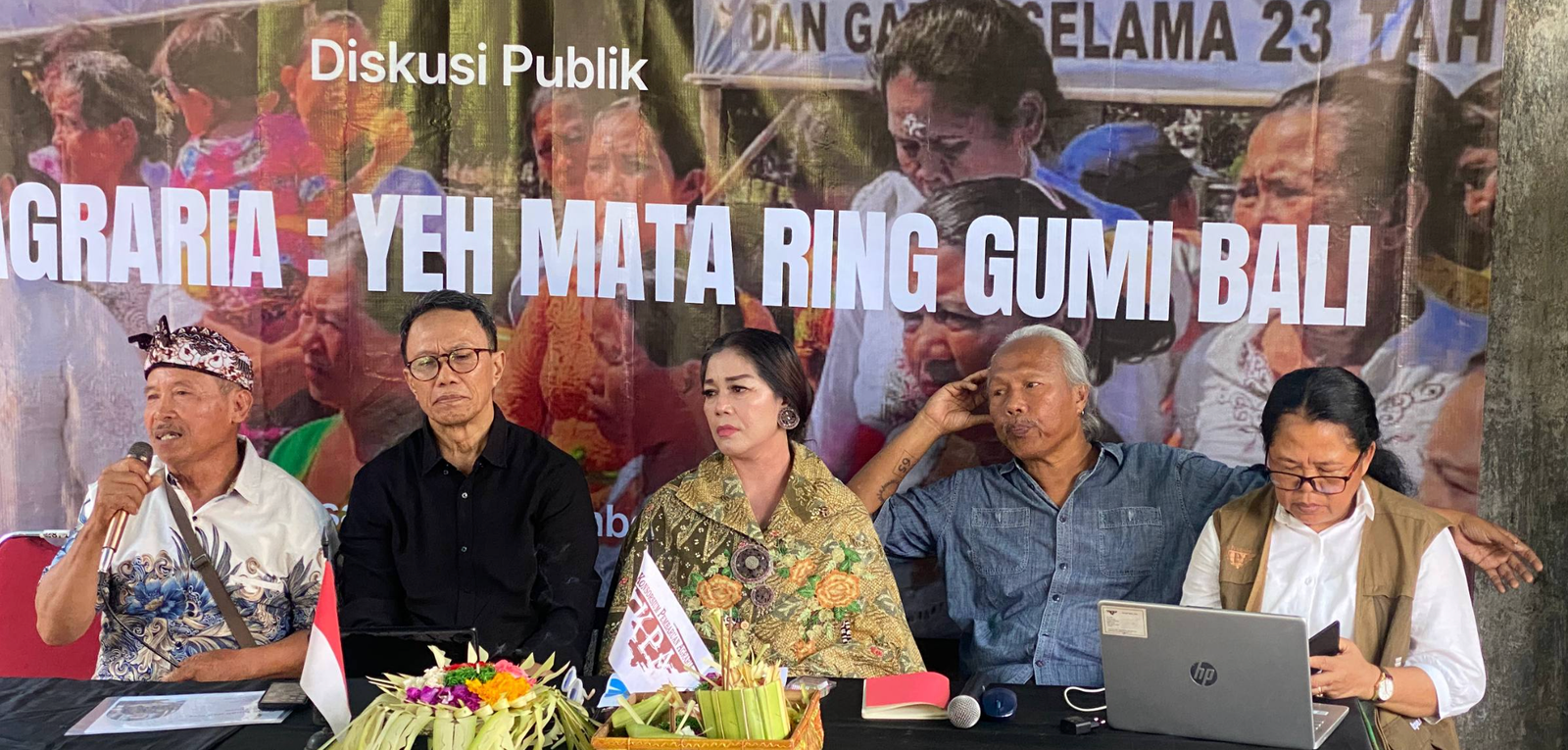
National Farmers’ Day discussion at Kubu Kopi
Every September 24, Indonesia commemorates National Farmers’ Day. The date was chosen to mark the enactment of Law No. 5 of 1960 on the Basic Agrarian Principles.
The law replaced the Dutch colonial agrarian legal system, which was considered unjust. Yet despite having a legal framework in place, agrarian conflicts continue to affect farmers, including farmers in Bali. Agrarian conflicts in Bali have persisted from the past to the present, with some cases continuing for years without legal certainty.
To commemorate National Farmers’ Day, the Bali Regional Office of the Agrarian Reform Consortium (KPA) and the Bali Care Forum held a public discussion titled “Agrarian Emergency: Yeh Mata ring Gumi Bali” (Tears of the Land of Bali). The discussion was held at Kubu Kopi on Wednesday, September 16, 2026.
Agrarian Conflicts in Bali
The memories of his transmigration experience to East Timor remain vivid for Nengah Kisid. In 1985, Kisid was among the Balinese who participated in the government’s transmigration programme to East Timor. He was 22 years old at the time.
After living in East Timor for approximately 15 years, Nengah Kisid and hundreds of other Balinese returned to Bali in 1999. Their return was linked to East Timor’s separation from Indonesia that year. In 2000, after spending one year in quarantine, Nengah Kisid was placed in Sumberklampok, Buleleng.
Upon returning to Bali, the former transmigrants experienced what Kisid described as a crisis of justice. They had lost their cultivated land and a clear means of livelihood.
“Imagine, we were clearly victims of the referendum. But when we fought for our rights during our time in East Timor, we were always confronted with regulations and laws,” Kisid explained.
The farmers became victims of policies, lost the benefits they should have received, and had to restart their struggle from the beginning. Kisid also highlighted the eviction of people who had lived in forest areas for years on the grounds that they did not possess land certificates.
“But we hear on social media that mangrove forests can easily be certified. Who is doing it? Certainly not ordinary people,” Kisid remarked.
People have also come under increasing pressure following the Job Creation Law, which introduced the Land Bank system. Made Pria Darshana, a land affairs observer, argued that the Land Bank policy is more oriented toward facilitating investment and serving oligarchic interests than toward agrarian reform for the people.
“The Land Bank has two faces. First, land for the people. Second, land for development. The question is, which one is more dominant?” Pria said.
Government Regulation No. 64 of 2021 established an official institution known as the Land Bank Agency. The agency manages state land to ensure land availability for public, social and national development purposes.
Through the Land Bank, people are offered limited forms of land rights, such as Management Rights (HPL), Building Use Rights (HGB), and Cultivation Rights (HGU) over state land, rather than absolute ownership rights.
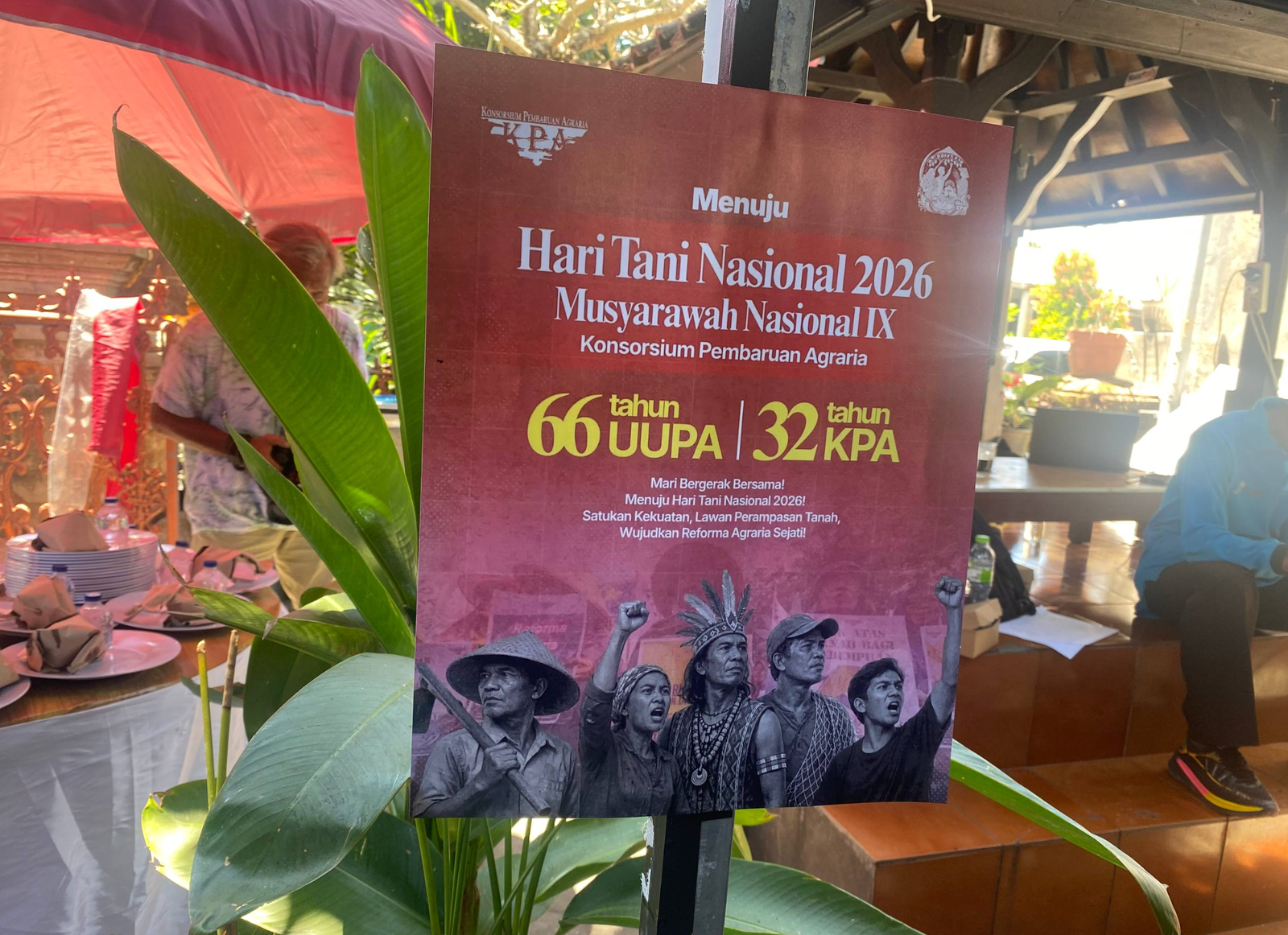
National Farmers’ Day commemorative poster
Pria emphasised that land is not merely an economic or administrative asset, but also a living space and ecological space for communities, carrying social and historical value. When people lose their living spaces, agrarian conflicts can become an inheritance passed on to future generations.
The Draft Agrarian Reform Bill is considered capable of addressing long-standing inequalities in land control. It is also seen as a means of resolving agrarian conflicts that have persisted for years.
Regarding the Draft Agrarian Reform Bill, Pria warned against the possibility of provisions being inserted at the last minute.
“The provisions that we later recognise as forms of oligarchic inequality are there. We are dealing with them, not with farmers who can only make their voices heard faintly,” Pria said.
Women in Agrarian Conflicts
In land conflicts, women are among the most vulnerable groups. This was highlighted by Ni Nengah Budawati of the Bali Women Crisis Center Legal Aid Institute (LBH Bali Women Crisis Center/BWCC).
Budawati argued that free land certification programmes could potentially put Balinese women at a disadvantage. Many land certificates are issued solely in the names of men as husbands or heads of households.
“Is it then discussed with their wives or not?” Budawati asked.
When family land is sold, women and future generations risk losing their living space as well as their ability to continue customary and cultural rituals. Losing land does not only mean losing an economic asset, but can also mean the psychological loss of family memories and a sense of belonging.
Ni Made Indrawati of the Bali Regional Office of KPA explained that the national constitution guarantees equal rights to land for men and women. However, under customary inheritance practices in Bali, land is generally inherited by men. Meanwhile, in 2010, the Bali Majelis Utama Desa Pakraman (MUDP) had issued a decision recognising inheritance rights for Balinese women.
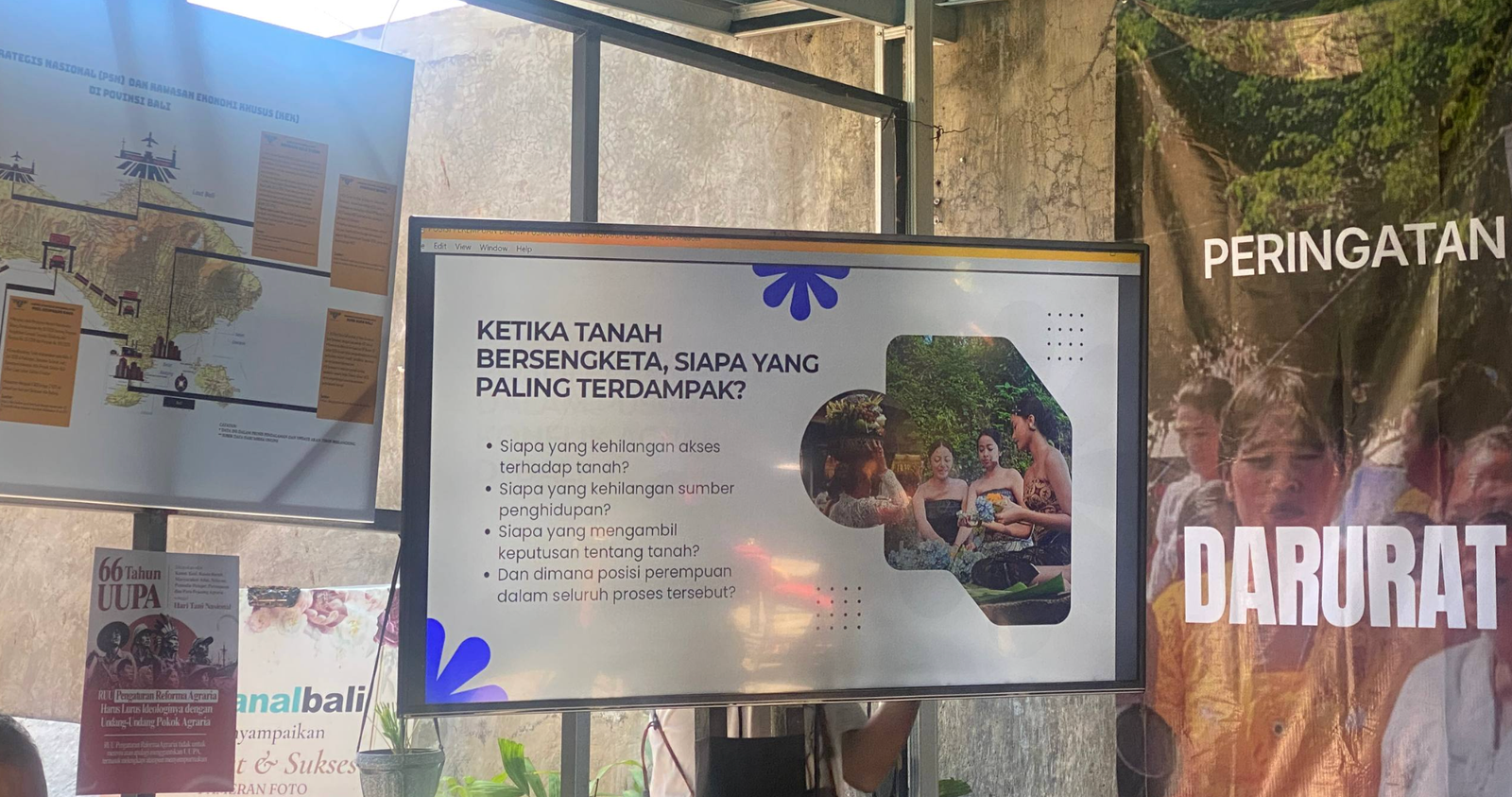
Presentation during the National Farmers’ Day event
In the agrarian conflict involving former East Timor transmigrants, women have been among those at the forefront of efforts to fight for land rights.
Indrawati also reflected on several agrarian conflicts she had assisted with, noting that 75 people had obtained land rights registered in women’s names. Even so, achieving this required lengthy debate.
“Because in Bali, it is still the man who is expected to receive the certificate. Women are not allowed. So we shifted the approach and used the Basic Agrarian Law, which states that every man and woman has the right to land. Except for customary land and ancestral land, that is a different matter,” Indrawati explained.
Budawati also proposed that land ownership adopt a family communal rights scheme, meaning that land would be jointly owned so that it could not easily be sold unilaterally.
The Roots of Agrarian Conflict
Agung Alit of Taman 65 explained that the mass killings of 1965 became a gateway for the rise of the New Order regime. According to Alit, the regime opened the door for foreign investors and oligarchs to control natural resources.
“In Bali, our mine is tourism. This is frighteningly complicated,” Agung Alit said.
The mass tourism that has developed in Bali does not reflect justice for local communities. Indigenous communities are often pacified by an emphasis on preserving traditions on a large scale. Meanwhile, their land and living spaces continue to be eroded by the development of villas and hotels for investors’ interests.
The Job Creation Law also introduced the Online Single Submission (OSS), a one-stop business licensing system. This system has contributed to the increasing practice of nominee arrangements in Bali, in which land or business ownership is held under another person’s name.
Mass tourism has generated agrarian conflicts that remain unresolved. KPA has promoted various regulations aimed at mitigating agrarian conflicts, including Presidential Regulation No. 86/2018, Presidential Regulation No. 62/2023, and the Draft Land Bill. However, these regulations are considered not yet optimal in resolving agrarian conflicts.
KPA is currently advocating for the Draft Agrarian Reform Bill, which was first initiated in 2004. The bill is now being discussed by the House of Representatives of the Republic of Indonesia (DPR RI) and is expected by its proponents to be enacted as a legal framework for resolving agrarian conflicts.
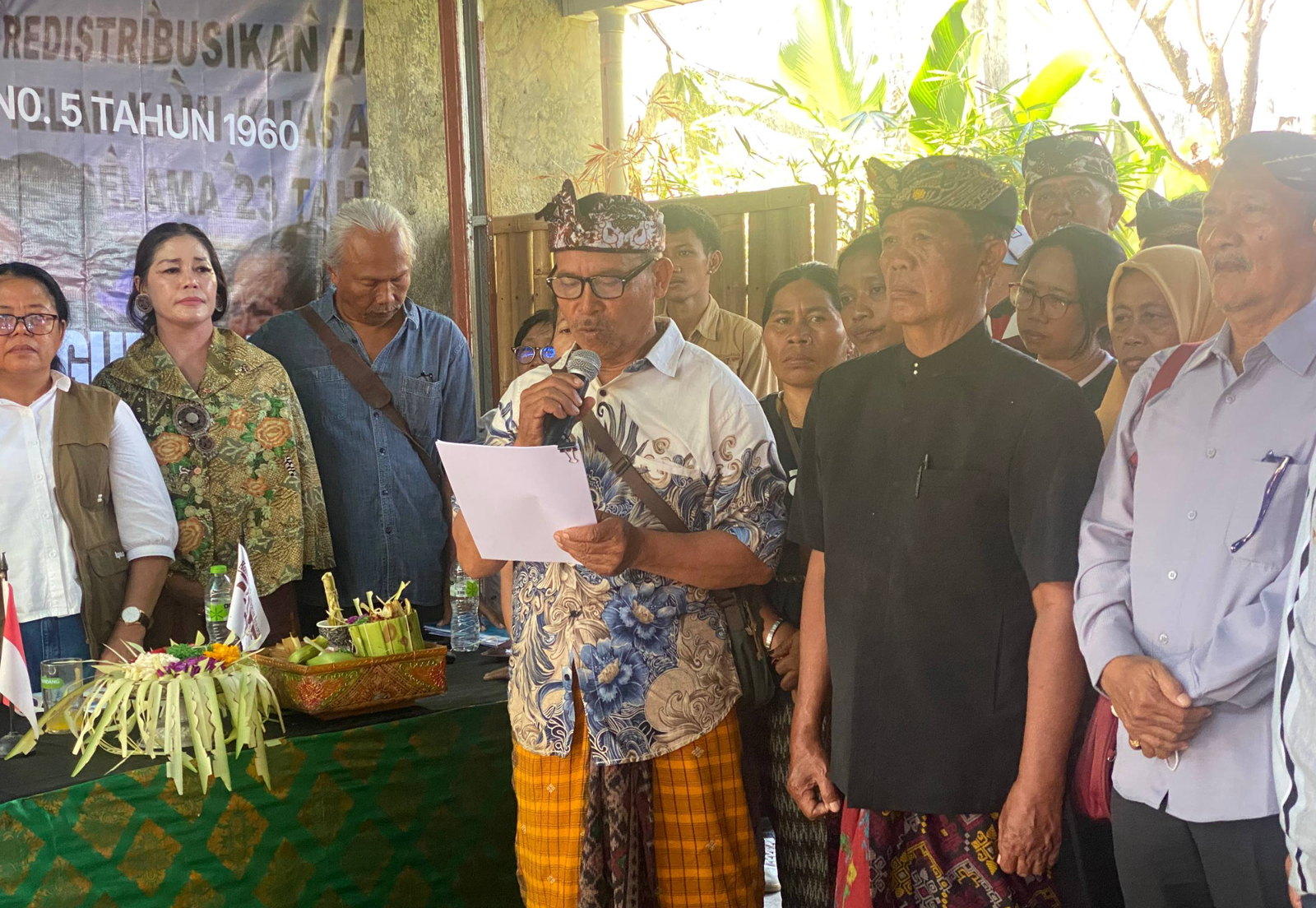
Statement of position by a coalition of civil society groups
KPA is also calling for the establishment of a National Agrarian Reform Agency under the President to implement the agrarian reform agenda.
Following the discussion, speakers from various backgrounds, together with civil society representatives, presented five demands as a joint statement:
- Immediately enact the Draft Law on Agrarian Reform, based on Article 33 of the 1945 Constitution, MPR Decree No. 9 of 2001, and the 1960 Basic Agrarian Law, with a focus on structural agrarian transformation.
- Make land redistribution and the resolution of agrarian conflicts the core of the Draft Agrarian Reform Law.
- Establish a strong agrarian reform implementing body that reports directly to the President and involves people’s organisations.
- Stop land grabbing, evictions, criminalisation, and violence against communities, and immediately resolve agrarian conflicts and redistribute land to the people.
- Build a unified agrarian reform movement, guaranteed by the Constitution, to uphold agrarian sovereignty.