Agrarian Emergency in Bali: From Land Inequality to Women's Voices
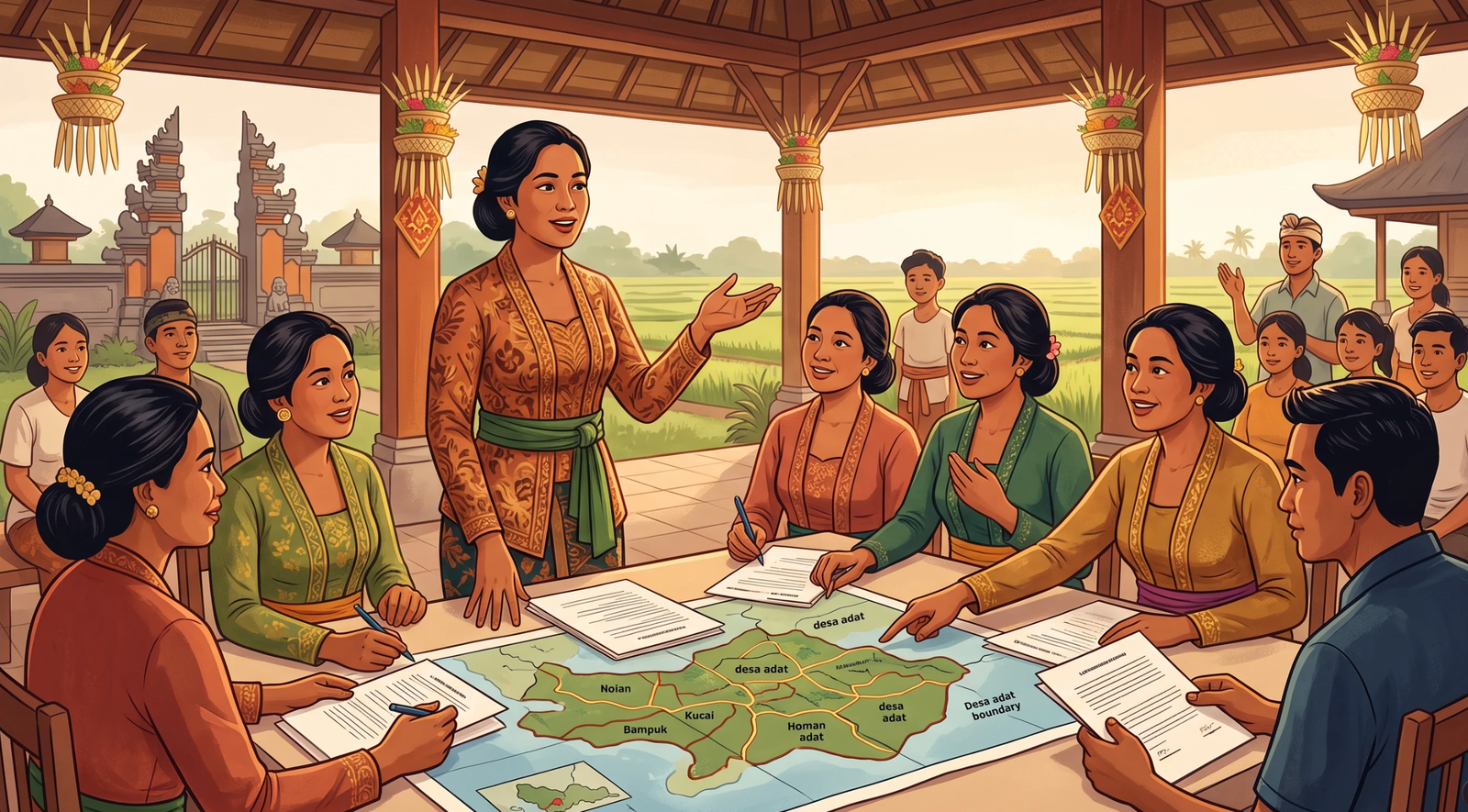
LBH Bali WCC Encourages Women’s Involvement in Land-Related Decisions (Pohto: Ilustration)
rri.co.id, Denpasar The Bali Women Crisis Centre Legal Aid Institute (LBH Bali WCC) encourages women to be involved in decision-making related to land within their families. Such involvement is considered important to prevent the loss of living spaces, cultural assets, and the sustainability of future generations.
Director of the Bali Women Crisis Centre Legal Aid Institute, Ni Nengah Budawati, said on September 16, 2026, that land issues are not only related to ownership and economic value, but also concern family life, customary practices, culture, and the sustainability of future generations. Budawati questioned the extent to which free land certification programmes have involved women in decision-making at the family level.
According to her, land certification can provide administrative certainty, but it needs to be accompanied by dialogue among family members regarding the management and use of the land. “When free land certification is available, people flock to obtain certificates, even entire villages. The loophole is that the men in our families control the land, the certificates are in their names, and they then sell the land or lease it out for very long periods,” she said.
Budawati questioned whether decisions to sell or lease the land had been discussed with wives and daughters within the family. According to her, this issue is important because when family land is sold, future generations may lose one of the resources that supports the continuity of their lives.
She gave the example that responsibility for maintaining the family home, sanggah, customary practices, and culture is also often passed on to children, including daughters. “The responsibilities related to maintaining the house, maintaining the sanggah, customs, and culture are carried by our children, especially our daughters,” she said.
Budawati said that the loss of family land does not only mean the loss of an economic asset. For women, losing land can also mean losing their connection to their place of residence, family history, and family life.
She cited the situation in Kintamani, where, according to her, communities are facing issues related to the availability and sustainability of land. When family land is depleted or changes ownership, communities also need to consider the sustainability of their livelihoods as well as the continuation of rituals and customary practices.
“There are things that are lost that are not merely property, but also family memories. Psychologically, for us women, that is very frightening, especially for future generations,” she explained.
For this reason, LBH Bali Women Crisis Centre encourages policy advocacy to ensure that women have space to express their views in decisions related to family land. Budawati stressed that Balinese women need to be involved in discussions when land that has long been part of family life is to be transferred or used for other purposes.
“Please include us, as daughters, in family discussions to ensure that decisions regarding the land controlled by our brothers or family leaders also take our views into account,” she stressed.
In addition to land ownership issues, Budawati also highlighted the ecological impacts of changes in land use. She said that LBH Bali Women Crisis Centre plans to plant 3,000 trees in the Kintamani area, including plants that can support the local economy as well as forest trees.
According to her, forests are closely linked to water availability and environmental sustainability. She also expressed concern about heavy equipment activity in hilly areas, which she said needs attention.
Budawati hopes that future land policies will not only view land as an asset that can be transferred or sold, but will also consider its social, cultural, ecological, and intergenerational functions. She stressed that women need to be involved in decision-making so that land management not only provides administrative certainty, but also helps protect the sustainability of family and community life.