Strengthening Access to Justice from the Village Level, LBH BWCC Conducts Paralegal Training through the KITA BERSUARA Program
Access to legal assistance is not always easy for communities, particularly when information, support services, and legal resources are not readily available within the community. In such situations, community paralegals play an important role as an initial bridge between communities and access to justice and legal services.
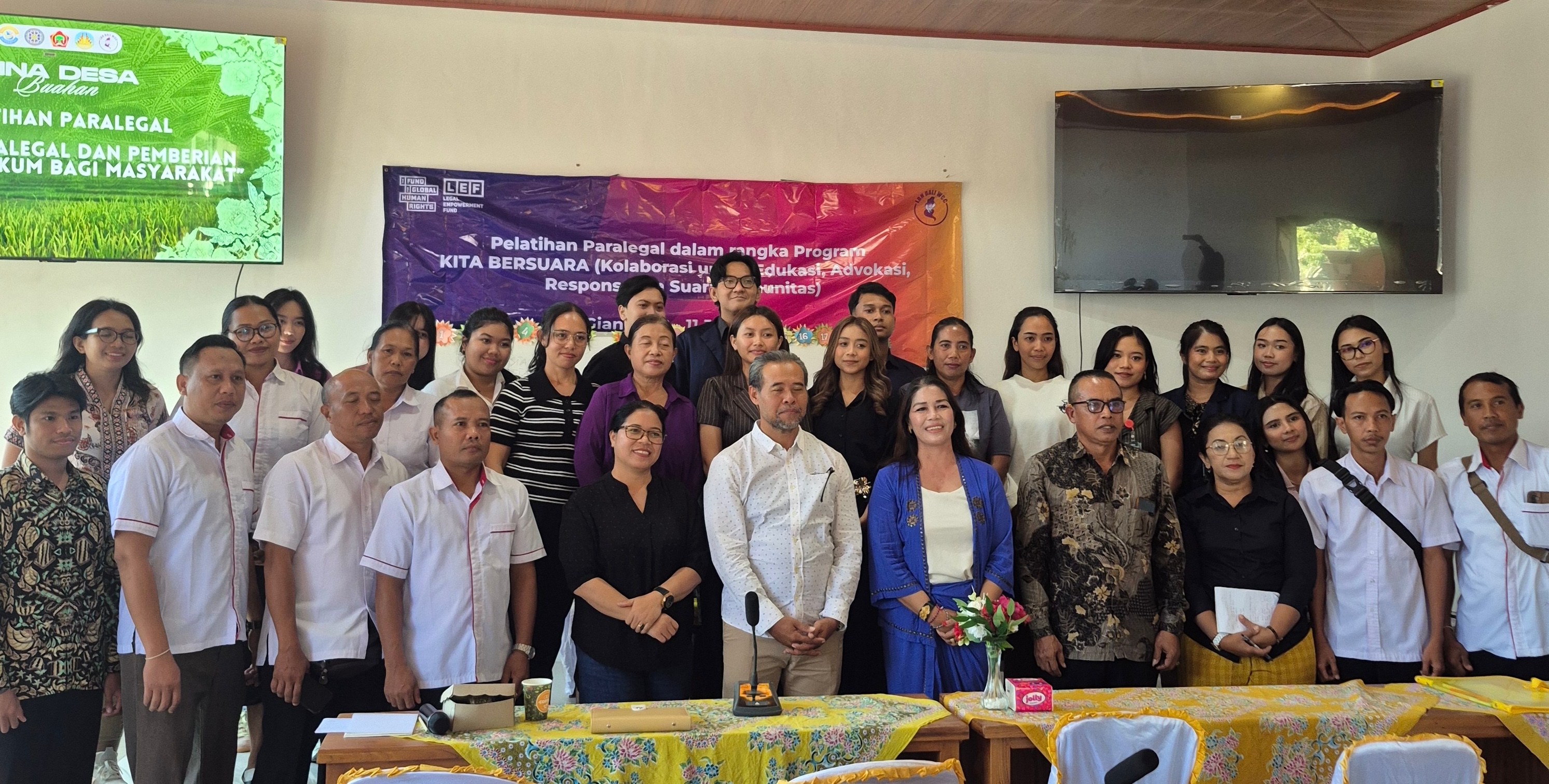
Through the KITA BERSUARA Program (Kolaborasi untuk Edukasi, Advokasi, Respons, dan Suara Komunitas/Collaboration for Education, Advocacy, Response, and Community Voices), Lembaga Bantuan Hukum Bali Women Crisis Centre (LBH BWCC) conducted a Paralegal Training from 9–11 June 2026 at the Buahan Village Office, Payangan Subdistrict, Gianyar Regency, Bali. The activity was supported by The Fund for Global Human Rights through the Legal Empowerment Fund (LEF).
The training brought together participants from diverse backgrounds, including community members, village officials, and university students representing young people. This diversity was important because strengthening access to justice requires the involvement of different elements of society, not only those with a legal background.
From understanding the law to supporting communities
Over the course of three days, participants received training on paralegal work, legal aid, Indonesia’s justice system, the rule of law and democracy, human rights, gender, vulnerable groups, communication techniques, report and chronology writing, and understanding community structures.
One of the key messages throughout the training was that paralegals are not substitutes for advocates, but play an important role in supporting communities at the initial stage, particularly through legal education, non-litigation assistance, community advocacy, and connecting people with legal aid organizations when further assistance is required. Paralegals must also understand the limits of their authority and maintain the confidentiality of legal aid recipients’ information.
During the session on paralegal communication, participants also learned that legal assistance requires more than knowledge of legal provisions. It also requires the ability to listen actively, communicate empathetically, and create a safe space for community members or survivors.
This is in line with one of the key principles that emerged from the training discussions: paralegals need to be able to identify issues, understand community needs, maintain confidentiality, provide accurate information, and recognize when a case needs to be referred to a legal aid institution (LBH), legal aid organization (OBH), or another authorized party for further assistance.
Paralegals therefore play an important role as a bridge between communities and access to legal assistance. Legal knowledge needs to go hand in hand with the ability to listen, understand people's needs, and recognize when a case requires referral.
Learning from real-life cases in the community
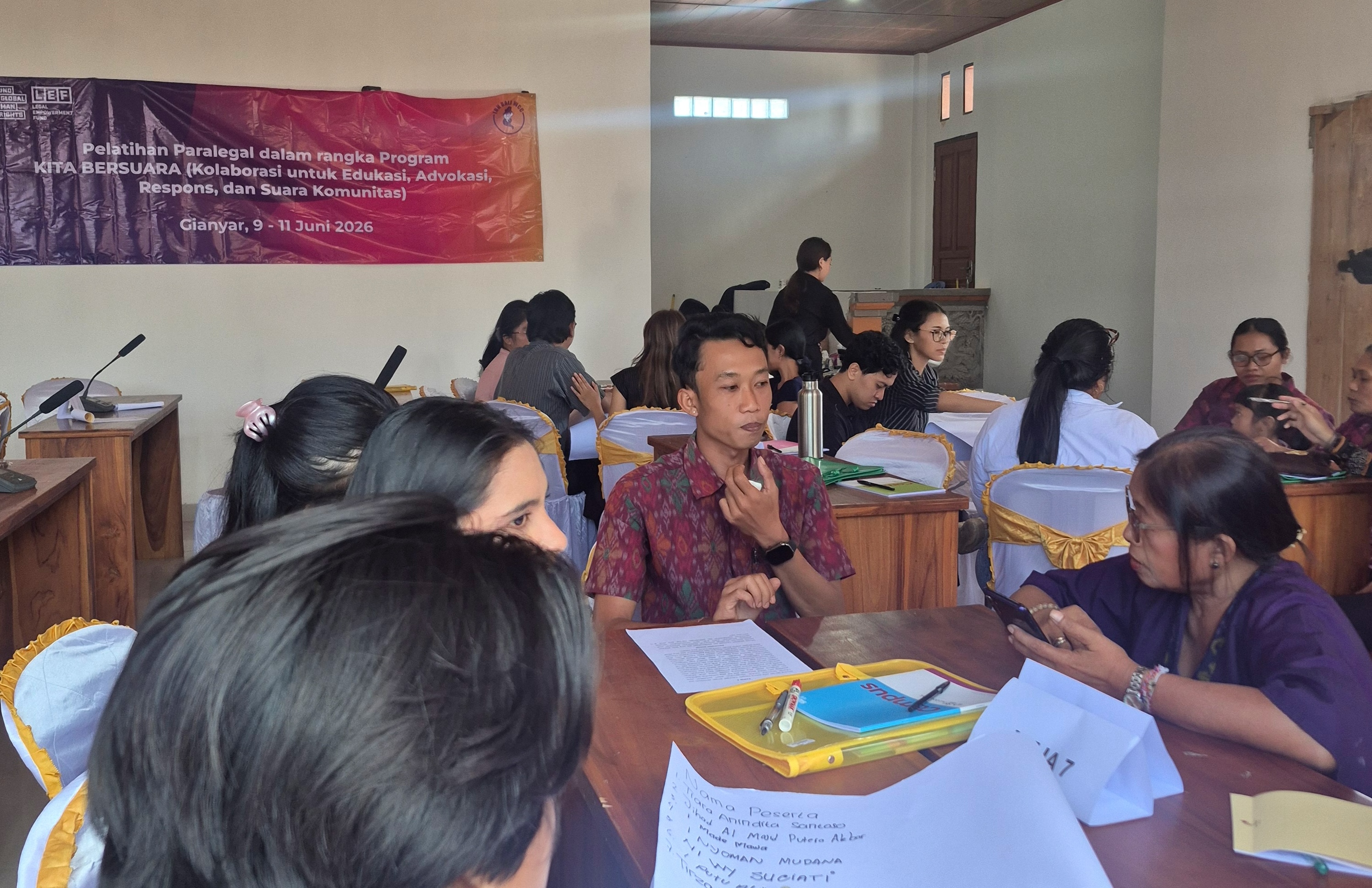
To connect the training materials with situations that paralegals may encounter in the field, participants took part in group discussions and case studies. The three groups discussed cases involving alleged sexual harassment in the context of a melukat, ritual, pada gelahang customary marriage, and a personal video linked to alleged extortion.
Through these discussions, participants learned that providing assistance goes beyond simply identifying the legal issue. Paralegals also need to consider survivors’ safety, identify their needs, document relevant facts and evidence, provide information about their legal rights, and make appropriate referrals when a case requires further assistance.
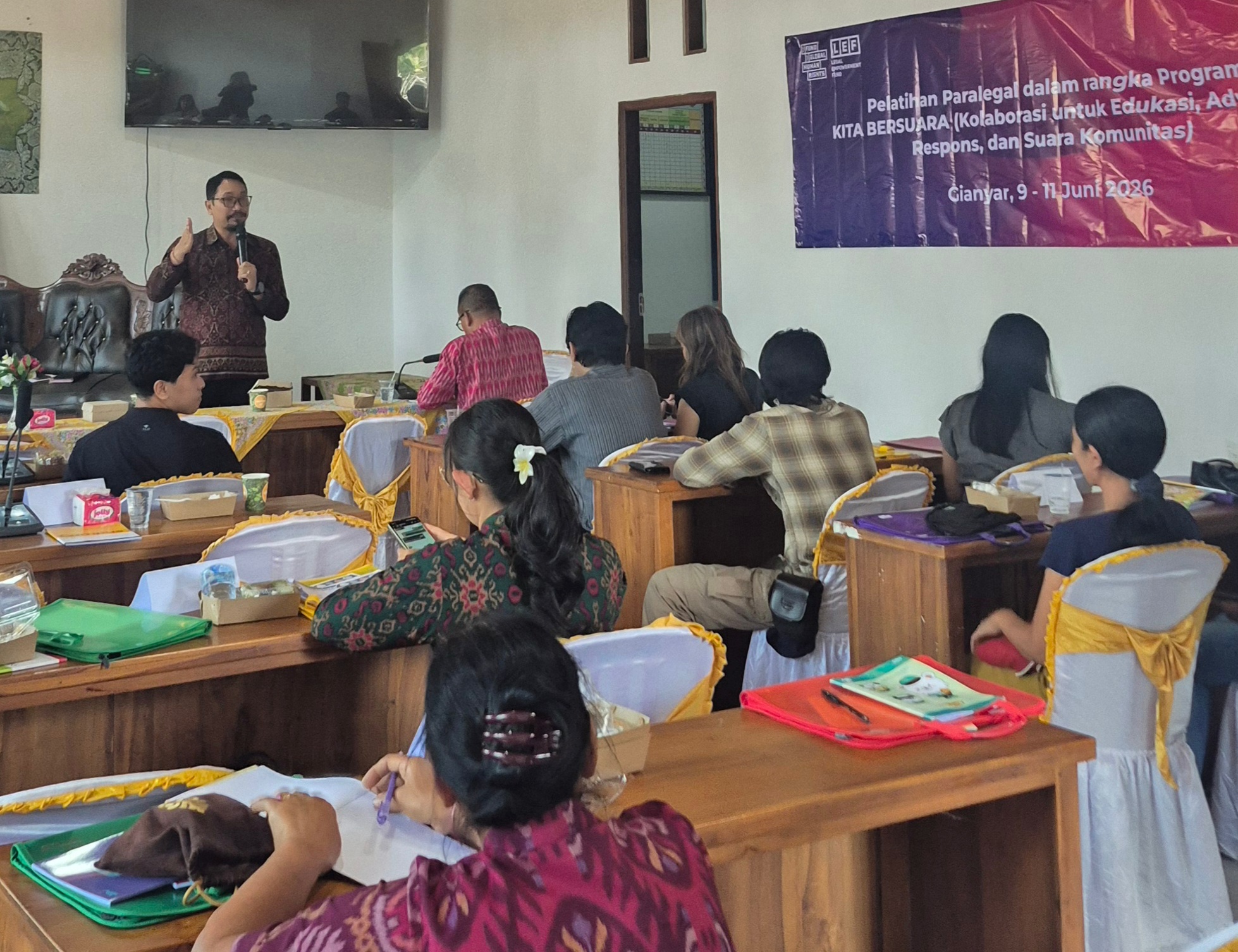
This approach is particularly important when working at the village level. In the session on community structures, Ni Ketut Sudiani emphasized the importance of understanding the local social structure and context before addressing a case. Building trust requires meaningful communication and engagement with the community, including coordination with the village government and other relevant stakeholders.
“Community-based assistance needs to begin with an understanding of the local context, building communication and trust, while respecting local norms and social relations without compromising the rights of survivors or the applicable legal framework,” Ni Ketut Sudiani explained to the participants.
For participants from the village government, this session was particularly relevant to their day-to-day work. Wayan Sudarsa, Head of Buahan Village, said the training broadened his understanding despite not having a legal background. “I can now serve as a bridge and help villagers who need legal consultation. The knowledge shared by the facilitators was very practical and useful for mediation and resolving conflicts at the community level,” said Wayan Sudarsa.
Meanwhile, I Made Mawa, Head of the Planning Affairs Division of Buahan Village, saw the training as an opportunity to gain a clearer understanding of the role, responsibilities, and limitations of paralegals at the village level. “After taking part in the paralegal training, we now understand the capacity and responsibilities of paralegals in the village,” said I Made Mawa. He also highlighted the importance of understanding that different community issues require different approaches, while knowing where to seek further assistance from legal aid organizations when a case requires more specialized legal support.
Young people connecting law with the realities of community life
The participation of university students was also an important part of the training. For young participants, the training provided an opportunity to see how legal knowledge can be applied in real-life community contexts..
Bulan Lestari, a law student at Udayana University, shared that the training broadened her understanding and helped her better understand how knowledge about paralegals can be applied within communities through practical, hands-on explanations.
A similar experience was shared by Ni Kadek Stifibi S., also a law student at Udayana University. For her, the training not only helped her understand what paralegals are and how they work, but also gave her an opportunity to engage more closely with real cases and meet practitioners who have been working directly in the field. As she put it, “I got the chance to get directly involved in cases and meet the inspiring people invited by LBH BWCC.”
Building safer spaces for women and children
For LBH BWCC, strengthening the capacity of community paralegals is part of its broader effort to expand access to justice, particularly for women and children experiencing violence. At the opening of the training, Ni Nengah Budawati, Director of LBH BWCC, shared the organisation’s experience in providing legal assistance and support to women and children, including in handling cases of violence in Gianyar.
She also emphasised the important role of paralegals in helping communities understand legal issues while connecting them with available legal assistance and support services. “Paralegals play an important role in bringing legal knowledge and access to legal assistance closer to communities, especially when someone needs a safe space to understand their situation and learn where to seek help,” said Ni Nengah Budawati in her opening remarks.
This role is particularly relevant as survivors of violence may still face various barriers to accessing legal services and recovery support, including limited information, social stigma, unequal power relations, and limited support services at the community level. Community paralegals can therefore serve as an initial point of contact, helping survivors access information, support, case documentation, and appropriate referral services.
From training to building stronger community networks
Ultimately, the paralegal training was not only about understanding the law. More broadly, it was an effort to build responsive, inclusive, and survivor-centred community networks that can help people access justice.
Over the three days, participants not only learned key legal concepts but also practiced looking at issues from a survivor’s perspective, understanding the role and limits of paralegals, communicating with community members, documenting cases, and identifying appropriate referral mechanisms.
For participants in Buahan Village, this knowledge is expected to serve as a practical foundation for responding to issues that arise within their communities. For university students and young people, the training provided an opportunity to connect legal knowledge with the realities of community life. For LBH BWCC, the training is part of a longer-term effort to strengthen community-based support systems.
Access to justice is not built only in courtrooms. It is also built in villages, within communities, and by people who are willing to listen, understand, and help others find a path toward protection and justice.
Access to justice starts with the community. Through the KITA BERSUARA Program, LBH BWCC continues to encourage the meaningful involvement of communities, young people, community advocates, and other stakeholders in creating safer, fairer, more inclusive, and violence-free environments.