National Farmers’ Day Commemoration Highlights Severe Agrarian Inequality and Conflict in Bali
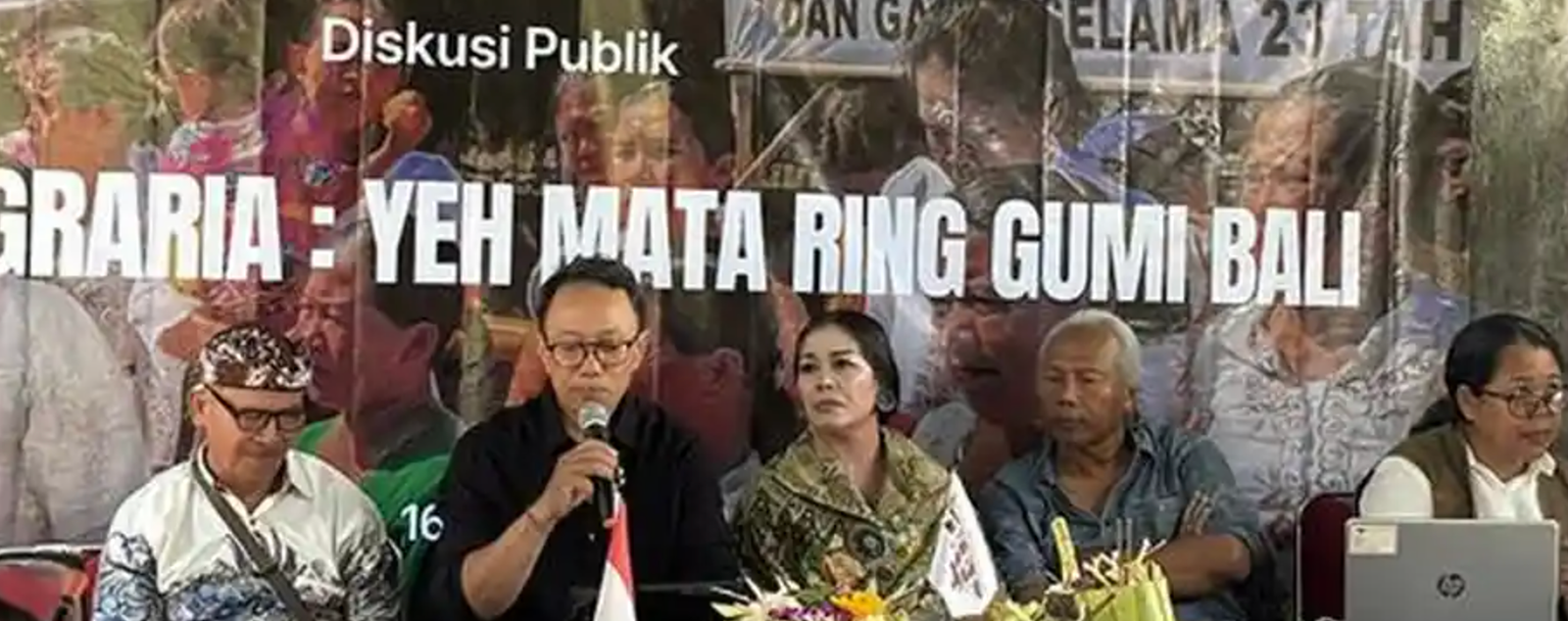
The Bali Regional Office of the Agrarian Reform Consortium (KPA), in collaboration with the Bali Care Forum, held a public discussion titled “Agrarian Emergency: Yeh Mata Ring Gumi Bali” at Kubu Kopi, Denpasar, on Wednesday, September 16, 2026.
Tribun Bali, Denpasar - The commemoration of National Farmers’ Day (HTN) and the 66th anniversary of the Basic Agrarian Law (UU PA) No. 5 of 1960 in Bali was marked by critical calls highlighting the island’s agrarian emergency.
The Bali Regional Office of the Agrarian Reform Consortium (KPA), in collaboration with the Bali Care Forum, held a public discussion titled “Agrarian Emergency: Yeh Mata ring Gumi Bali” (Tears of the Land of Bali) at Kubu Kopi, Denpasar, on Wednesday, September 16, 2026.
The discussion, which brought together academics, legal practitioners, socio-cultural observers, and farmers’ representatives, highlighted widespread inequality in land control, threats to the conversion of living spaces, the marginalisation of indigenous communities, and the urgent need to enact the Draft Agrarian Reform Bill (RUU RA), which is currently being discussed by the House of Representatives of the Republic of Indonesia (DPR RI).
Chairman of the Buleleng Farmers’ Union, Nengah Kisid, described the harsh realities faced by farmers in areas affected by agrarian conflicts. As a former participant in the government’s model farmer transmigration programme in 1985 who became affected by policies following the East Timor referendum, he argued that the country is currently facing a clear crisis of justice.
“The biggest problem the country is currently facing is a crisis of justice. Imagine, we were clearly victims of the referendum policy. Yet when we fought for our rights, we were always confronted with regulations and laws. Victims of policies should be addressed through policies, not by confronting them with laws,” Nengah Kisid stressed.
He also highlighted what he described as an irony in the enforcement of agrarian law, which often marginalises people living in settlements compared with wildlife in areas claimed as forests, while selective treatment occurs in the certification of coastal land.
“The animals and wildlife in these forests must be protected and their populations preserved. Meanwhile, people who have lived there for hundreds or even thousands of years, in areas claimed to be forest zones, are evicted on the grounds that they do not have certificates. Yet we hear on social media that mangrove forests can easily be certified. Those carrying this out are certainly the people in power,” he added.
Nengah urged the DPR and the government to immediately enact the Draft Agrarian Reform Bill in order to address the continuing escalation of agrarian conflicts.
Legal practitioner and notary in Badung Regency, Dr. I Made Pria Dharsana, S.H., M.Kn., criticised the orientation of land management since the enactment of the Job Creation Law and the establishment of the Land Bank Agency (under Government Regulations No. 18/2021 and No. 26/2021). He warned that the concept of land banking must not be shifted into a tool for legalising land control solely for investment interests.
“When the state accumulates land, we need to ask: land for whom? Land is not merely an asset. Land is a living space. So if land is accumulated by the state, we must not allow people to lose their living spaces as a result,” Made Pria Dharsana said.
Dharsana also emphasised that land certification programmes such as the Complete Systematic Land Registration (PTSL) do not address the substance of agrarian reform if they fail to ensure fair land control for ordinary people.
“Agrarian reform is not merely about distributing land. Agrarian reform is about distributing justice. What is at stake is not only land, but the future of the people. KPA has already warned about this.”
“Do not conflate agrarian reform with the provision of land for investment, because the two have different objectives. Agrarian reform is about social justice,” he explained.
He also warned that the drafting of the Agrarian Reform Bill in the DPR RI must be closely monitored to prevent the insertion of compromise provisions that serve oligarchic interests.
From the perspective of gender equality and women’s rights, Ni Nengah Budawati, Director of LBH Bali Women Crisis Center (BWCC), offered a critical reflection on the socio-psychological impacts of mass land certification schemes.